
The Price of Convenience: How Digital Finance Changes the Way We Spend
Paying for something has never been easier. A few years ago, buying something usually involved taking out a wallet, counting cash, entering a PIN, or physically visiting a shop. Today, a purchase can happen with a tap of a card, a smartphone, a smartwatch, or a single click online.
This convenience has transformed everyday financial life. Digital wallets, contactless payments, mobile banking and online shopping allow people to manage money quickly and efficiently. For young adults in particular, digital finance is simply part of everyday life.
But convenience comes with a less obvious effect: it can change how we perceive spending.
When we hand over cash, the transaction is tangible. We physically see money leaving our possession. Digital payments remove much of that experience. A €3 coffee, a €15 online purchase or a €30 subscription can all be completed almost without interruption. The transaction becomes a few seconds on a screen rather than a visible exchange of money.
This reduced friction can be useful, but it can also make spending feel less significant. When payment is effortless, it becomes easier to make decisions without stopping to consider whether the purchase is actually necessary or how it fits into the wider financial picture.
The same principle applies to online shopping. Digital platforms are designed to make purchasing as easy as possible. Saved payment details, personalised recommendations, one-click purchasing and instant confirmation all reduce the number of decisions between wanting something and owning it. The shorter this process becomes, the less opportunity there is to pause and reconsider.
This does not mean that digital payments automatically lead to irresponsible spending. Convenience can also have positive effects. Mobile banking makes it easier to monitor accounts, transfer money, set up regular savings and keep track of transactions. Digital tools can give people greater visibility and control over their finances – provided they actually use those tools.
The challenge is therefore not technology itself. It is awareness.
Digital finance can make the distinction between spending and not spending increasingly subtle. Subscriptions may renew automatically. Small purchases can accumulate without being noticed. Buy-now-pay-later services can separate the moment of purchase from the moment when the full financial cost is felt. Digital platforms can also encourage frequent transactions through personalised offers, notifications and limited-time promotions.
This creates an interesting paradox. Financial technology gives us more control over our money while simultaneously making some forms of spending easier to overlook.
That is why financial literacy in a digital environment requires more than knowing how to use a banking app. It also requires understanding our own behaviour. Before making a purchase, it can be useful to ask a simple question: “Would I still make this decision if paying for it required more effort?”
The answer can reveal something about the role of convenience in our spending habits.
Another useful habit is to look at spending cumulatively rather than individually. A €4 purchase may not seem significant. Neither does a €7 subscription or a €10 delivery fee. But when similar transactions happen repeatedly, their combined effect can become much more substantial. Digital banking tools can actually help here by making it possible to review spending patterns and identify where small amounts are going.
This is where financial education needs to move beyond traditional budgeting. Knowing how much money is available is important, but understanding why we spend it is equally valuable. Are we buying something because we need it, because it is convenient, because we are bored, because everyone else seems to have it, or because the purchase requires almost no effort?
These questions bring financial literacy closer to behavioural awareness.
For young adults, developing this awareness early can be particularly valuable. Digital financial habits are being formed at the same time as many other adult routines. Learning to recognise the psychological effects of convenience can help individuals establish more deliberate relationships with money before automatic spending patterns become deeply established.
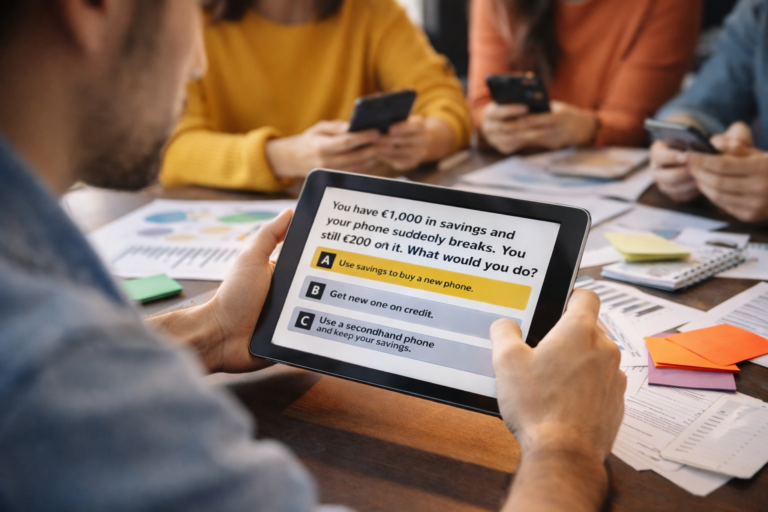
This behavioural perspective is closely connected to the approach of the FINMAN+ project. Rather than treating financial literacy simply as a collection of concepts and rules, FINMAN+ focuses on how people actually make financial decisions in everyday situations. Through scenario-based learning, participants can explore realistic choices, consider their consequences and reflect on the factors influencing their behaviour.
Digital finance provides an ideal context for this approach. A scenario involving an online purchase, a subscription, a digital wallet or an unexpected payment can reveal much more than whether someone understands a financial concept. It can show how convenience, emotions, habits and social influences interact when a real decision has to be made.
Ultimately, convenience is not the enemy of good financial management. The important question is whether convenience is helping us manage our money – or quietly making decisions for us.
In a world where spending can happen with a single tap, sometimes the most valuable financial habit is simply learning to pause before that tap.